Xswap token creation - Base Deployment and Cross-Chain Expansion
Xswap token creation uses the no-code Token Creation Platform (TCP) for an initial token deployment on Base. Creators configure a name, symbol, and total supply before issuance. Chainlink’s Cross-Chain Interoperability Protocol (CCIP) supports later connections to additional blockchains. TCP also integrates XSWAP into its liquidity model. The launch decision turns on whether Base meets the immediate requirement, which token parameters need to be settled, and whether access to another network must be ready from the outset.
Successful issuance on Base can meet a Base-only launch plan; another network requires a supported CCIP connection.
Base, CCIP, and XSWAP in the Launch Plan
Base hosts the initial token, while CCIP supplies the infrastructure for extending it beyond that network. XSWAP has a separate role in establishing liquidity for tokens created through TCP. A launch plan needs to identify the starting network and the intended use of the token.
Base deployment can meet a launch requirement confined to that network. A project that needs another blockchain immediately has an additional compatibility question. It needs a supported expansion for that token, as well as the Base issuance. The platform’s cross-chain design provides a mechanism for broader access; it does not make every destination available automatically.
Name, Symbol, and Supply Before Deployment
The configuration interface covers the token’s name, symbol, and total supply without requiring the creator to write code.
The name and symbol identify the new asset in ordinary use. Total supply sets a quantity of tokens; it does not set their market value. A larger number in that field cannot establish deeper liquidity or greater demand. Keep the chosen quantity and its token unit explicit in the launch notes. Review the spelling of both identifiers before deployment. A symbol also cannot identify a deployed contract uniquely; its network and address distinguish the actual asset.
What Does Deployment on Base Establish?
A successful deployment establishes that the new token exists on Base. Confirm the completed on-chain deployment and the resulting token address. A populated form or submitted request establishes an earlier state. Base deployment does not establish availability on another blockchain or confirm sufficient liquidity for an intended trade.
Can Cross-Chain Expansion Wait Until Later?
Cross-chain expansion can follow the Base launch because TCP places that connection after initial deployment. Creators can connect the deployed token to additional networks through Chainlink CCIP. A launch that needs another network immediately must resolve that requirement before treating Base deployment as sufficient.
CCIP provides the interoperability mechanism, while the intended destination requires its own compatibility assessment. A list that describes where an existing asset can be swapped or bridged does not, by itself, establish where a newly created TCP token can connect, because these are different product operations.
A Base Launch With Expansion Deferred
In this hypothetical launch, Base alone meets the immediate requirement. The creator has chosen the name, symbol, and supply, and Base deployment is available. Support for the intended additional network remains unconfirmed. The creator wants to avoid committing to expansion until that missing prerequisite is resolved.
The creator uses TCP’s configuration and Base deployment flow, leaving the additional-network decision for later. Once deployment succeeds, the resulting token address is retained with the Base network designation. An independent check uses a Base block explorer to confirm the contract’s existence and its successful deployment record. A token name displayed in the interface alone would not establish that outcome.
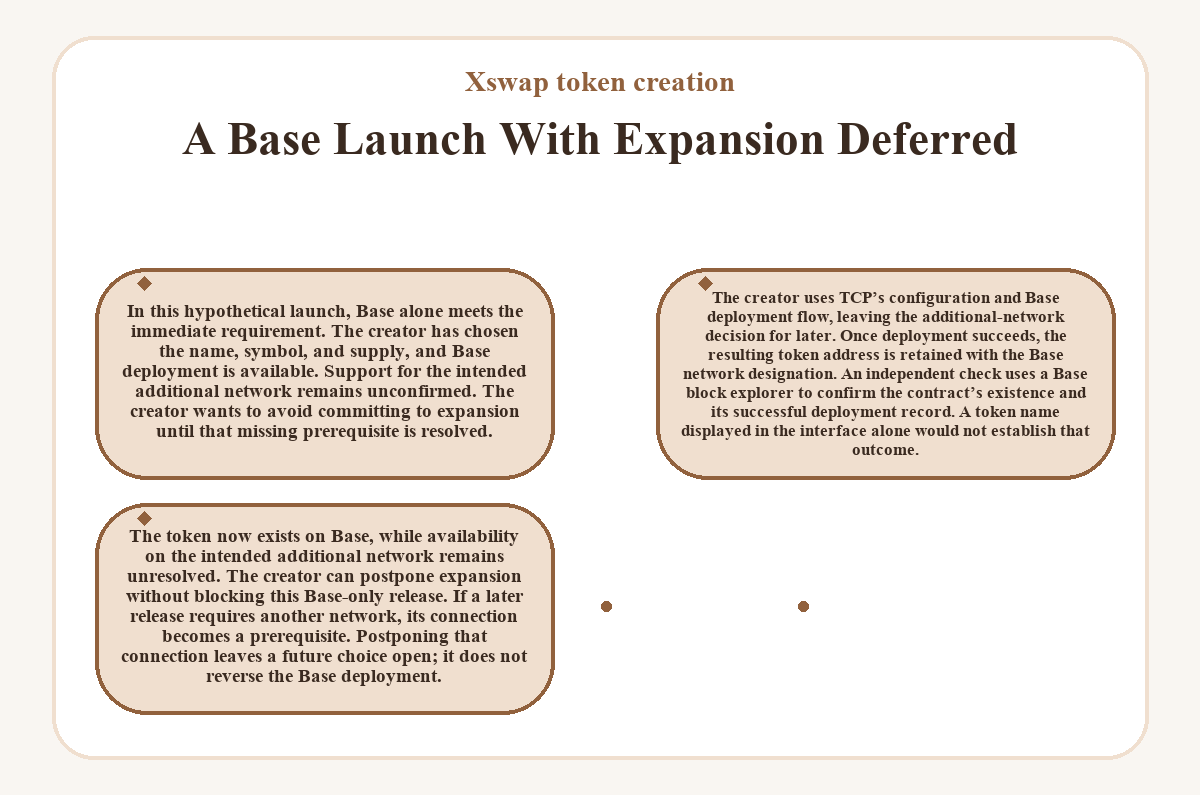
The token now exists on Base, while availability on the intended additional network remains unresolved. The creator can postpone expansion without blocking this Base-only release. If a later release requires another network, its connection becomes a prerequisite. Postponing that connection leaves a future choice open; it does not reverse the Base deployment.
XSWAP Liquidity and Trading Conditions
TCP integrates XSWAP as its native liquidity token. This integration helps establish markets for newly created assets. The liquidity arrangement is distinct from the chosen token supply and any later CCIP connection. Actual trading conditions concern the particular market, including available liquidity and the executable quote. XSWAP’s role alone cannot establish how much liquidity will be available for an intended trade. Issuance and trading readiness therefore need separate consideration when the launch requires an immediately usable market.
Creator Participation and Graduation
TCP includes a 0.6% creator participation share from the trading activity of each project launched through the platform. This allocation is separate from the token’s configured total supply. The percentage describes an activity-linked benefit; it does not establish a fixed cash amount available to fund the launch.
Projects reaching the program’s “graduated” milestone may also qualify for a $1,000 builder grant. The milestone is based on community traction and on-chain engagement. Creating a token alone does not establish grant eligibility or an automatic award.
Records for Later Network Expansion
Launch records should identify the token by network and contract address, alongside the parameters intended at creation. Keep the successful deployment record with that information. These details distinguish the asset even if another token shares its symbol. For later CCIP expansion, retain the Base record and identify the additional network and connected token separately. A successful deployment confirms issuance on its recorded chain; it cannot establish the present availability of every later connection. Revisit destination support when the project adds a network requirement or changes its expansion configuration.
Xswap token creation: the short answers
-
Which Costs Belong in a TCP Token Launch Budget?
- A TCP launch budget needs the Base deployment cost and any platform charges that apply to the chosen launch. Base’s low-cost positioning does not define an all-inclusive price. Review the costs presented for the deployment action before committing. Do not assume that a later cross-chain expansion falls within the same quote.
-
How Quickly Can TCP Create a Token on Base?
- TCP targets token issuance in seconds, with completion established by the successful Base deployment. Creation speed alone cannot establish when a token will be usable on another network. Initial issuance and later CCIP connectivity involve different work, so a launch requiring both must account for the additional connection.
-
Can I Change the Token Name or Supply After Deployment?
- A later edit requires the deployed token contract to support that change and authorize the caller. Being able to set a field during creation does not establish permission to rewrite it afterward. If an editable name or adjustable supply is essential, confirm that control for the actual token contract before launch.
-
Do Creators Need to Build a Separate Bridge for TCP Expansion?
- TCP uses Chainlink CCIP to connect created tokens across networks without requiring creators to implement a complex bridge. The expansion still needs to support the intended token and destination. CCIP’s interoperability role does not make every destination available for every created token.
-
Is a TCP-created Token Automatically Audited Through CCIP?
- CCIP supplies cross-chain interoperability; its use does not establish an audit of every token contract created through TCP. A contract audit concerns a specific implementation and scope. Any audit assessment needs to cover the implementation that the deployed token actually uses.